
Our Heritage Waters

My paternal grandfather Aaron ran the family farm in northernmost New Hampshire. He and my grandmother Flora did literally everything there to support their extended family and community: he by milking a half dozen dairy cows at 5:00 am and 5:00 pm every darn day, hauling in that milk for her to churn, farming corn and hay, maintaining a large vegetable garden, raising hogs, chickens and doves, selling manure for fertilizer, running the town store and, earlier in his life, serving as the town constable. They also ran a logging operation and a sugar bush, where at age 4 I fell into my first spring.
All that and he looked the other way as we pilfered candy from the jar in the store. He took the time to take us kids into New Hampshire woods to fish for brook trout. And each August he’d drive his Willys Jeep station wagon over to the Maine coast and haul back a 55-gallon drum of lobsters for a town cook-out. Generous, loving, and hard-working to the core, taciturn but with a wry twinkle in their eyes, my grandparents showed us what it takes to be creative, productive, independent, compassionate human beings. Do everything you can and hope that at least some of that effort bears fruit. That’s what it took to raise their family in a landscape with little soil, a short growing season, and winters where it regularly drops so far below freezing the thermometers break. My sisters and I live by the lessons and values they taught us, paying keen attention to Nature and the people around us with love and humor.
One of my sisters now lives on a small farm in eastern Pennsylvania, where she and her husband run a cottage industry producing lady’s accessories, and he supplements their income with construction work and motorcycle restoration. Like my grandfather, her husband can do pretty much anything that needs doing, and they both apply themselves to their worldly presence with vim, great vigor and creativity. She makes the most astounding handbags out of metal, and generously donates sales of “The Butterfly Bag” to SSI.

Despite the fact that most of the thousands of farms in their state are founded on springs, and that many of those farms still rely on that groundwater, Pennsylvania - like many states - does not pay much attention to its springs. With its humid environment, water is often more of a problem of excess than of deficit; however, there - like everywhere - springs play important roles in landscape, wildlife, and human well-being. And as nearly everywhere, springs have been largely overlooked, particularly as the fracking boom has taken off, pulling natural gas from the Marcellus Shale. This gas-rich stratum underlies three quarters of the state. Although producing a great surplus of natural gas and the promise of lower energy prices, home electricity costs in Pennsylvania have risen 31% over the past five years, and the environmental costs to groundwater supplies, many claim, have been irreversible.


My sister and brother-in-law have a couple of unmapped, unnamed springs on their farm, the largest over which the original settlers constructed a springhouse nearly 200 years ago. It was originally used as a space to prepare, smoke, and cool-store meat, vegetables and fruit. The Rorbachs, who lived on the farm for several generations, also stored milk there. They loved to eat sandwiches with watercress collected from the springbrook that emerges from the springhouse. Such springhouses are common and most farms, many dating to pre-revolutionary times, have and maintain these architecturally distinctive structures, although they are increasingly used to cool wine and beer.
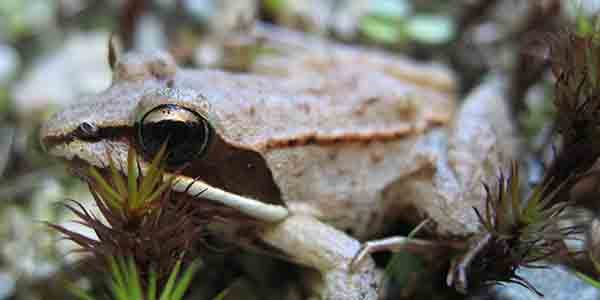
My sister’s farm spring upwells and flows into a concrete pool outside the springhouse, its flow creating a springbrook that feeds a bog and then merges into a larger stream, sourced by yet other springs half a mile up the valley. When I was there two week ago the wood frogs (Lithobates sylvaticus) had just awakened from their winter sleep in the surrounding woodlands, and congregated in great numbers in the springhouse pool. Their guttering, inharmonious croaks erupted every time we stepped away from the pool, in a manner that, I hope, has more sex-appeal to their females than it did their human audience. Later in the spring, my sister assured me, spring peepers (Pseudacris crucifer) and other amphibians would make their appearance. While not strictly springs-dependent, all of these populations benefit by having access to groundwater emerging in undisturbed wetland habitats.


In addition to frogs, toads, newts, snakes, and the many birds and terrestrial wildlife around those waters, her farm springs provide a refuge for federally threatened Bog Turtles (Glyptemys muhlenbergii). These small, shy emydid turtles, with their crisply etched shells and brialliant yellow-orange ear patches, spend their summers crawling along streams and wetands. They breed in her bog and other wetlands in the area. But come autumn, they make their way up to the springs, and brumate (turtle for “hibernate”) in the mud at the edge of the spring. A coldwater spring, it maintains a constant water temperature through the winter that is slightly warmer than freezing. Although some turtles (how to say this in a way that doesn’t get the kids thinking too deeply?) can respire through their cloacae, brumating Bog Turtles absorb oxygen through their skin as they sleep. So, the springs on my sister’s farm provide essential over-wintering habitat for this species. Bog Turtle endangerment is, of course, related to habitat disruption and loss, but federal protection allows some progress in bolstering their populations, as long as the government continues to honor the Endangered Species Act.
These are but a few examples of the way springs, even those in humid regions like Pennsylvania, matter to Nature and humans. My sister’s farm springs support a plethora of species that benefit from minor attention to the health of the land. These are also the stories of people who demonstrate committed and compassionate attention to their families, communities, and society, people who enrich and inspire all of our lives. Please do what you can, at whatever level you can, to protect and care for the innocent lives, lands, and species that are unraveling in the wave of senseless inhumanity sweeping our world.
And if you can, we deeply value your continuing support the Springs Stewardship Institute. With your grace, we will continue to work towards improving knowledge and management about these rich, unique, essential, but unheralded ecosystems.