
Sunk Falcon

Springs are highly multi-dimensional ecosystems, with many overlapping layers of processes and interactions that make it difficult to understand, much less manage them. As everywhere in life, what, why, how, when, and whether we choose to notice often wholly contrasts with the reality around us. Siloed obliviousness is abundantly evident to me personally and in the trajectory and manifestations of our on-going cultural dementia and political delusion. Strabismic bias shelters us from personally having to face our insignificance in the largesse of time and space, the inevitability of unwanted change, and death. We survive by filtering out those perceptual challenges, embracing blindness, shutting the doors of compassion in our hearts, and cutting off vision that prevents us from confronting the vast uncertainties around the circled wagons of our pathetic attempts at self-protection.
To me, the pursuit of art provides a multi-dimensional means to more clearly grasp the evolutionary significance of human ignorance, lassitude, and malice, and to refresh my eyes to the wonders and complex interactions we all know to be this miracle of life. Art is a perceptual discourse - an intuitive discussion of human nature and spirit, and a path to more clearly understand the fundamental conditionalities as parables and warnings. In artistic discourse, I most appreciate works that cannot be comfortably pigeon-holed into the confines of my prescribed perception. Some call this abstract environmental activism, an activism focused not at some political issue but one aimed at improving one’s own sense and sensibility.
Often while conducting spring inventories we come across odd features in the landscape that reveal far more robust human interactions with the landscape than have been recorded. Chert or obsidian flakes, pot shards, and grinding holes indicate the extent of indigenous use, with springs featuring prominently as hunting and gathering points in the landscape. Large, hand-carved dugout logs used as watering troughs, an old cedar fence posts, and rusty piping and metal livestock tanks tell of the efforts to which early settlers went to secure water for subsistence uses. Railroad tie, abandoned vehicles, a lonely electrified concrete box over a well, or an earthen berm revealing a spot where groundwater once emerged, all as footnotes on unrecorded histories.
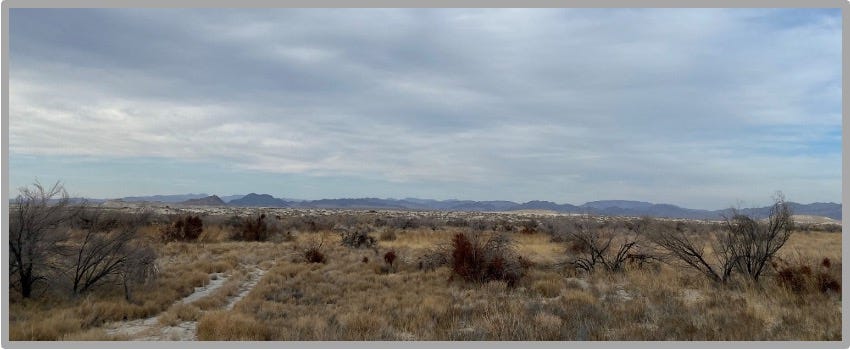
Lying in the southern part of the Amargosa Valley in southern Nevada, the 20,000-acre Ash Meadows National Wildlife Refuge protects more than 100 springs and supports the highest concentration of endemic, springs-dependent plants, invertebrates, and fish species in the coterminous United States. The Refuge was established when Endangered Devils Hole Pupfish (Cyprinodon diabolis) were threatened by unregulated agricultural development. In tensive agricultural development threats turned the valley and its underlying aquifer into a conservation battleground five decades ago. Recognizing its biodiversity significance, Ash Meadows was transferred to the U.S. Fish and Wildlife Service for protection of its habitats and species in 1984.
To me, Ash Meadows is the holy ground for desert springs conservation, and the aquifer beneath the valley floor requires full and unequivocal protection from further development. However, a lithium mining claim just outside its northern boundary re- exposed the inadequacy of groundwater protection. Rover Critical Minerals’ proposed lithium mine on the Bureau of Land Management district immediately north of Ash Meadows threatened to dewater Ash Meadows springs. So once again, we stood to lose Ash Meadows to commercial exploitation.
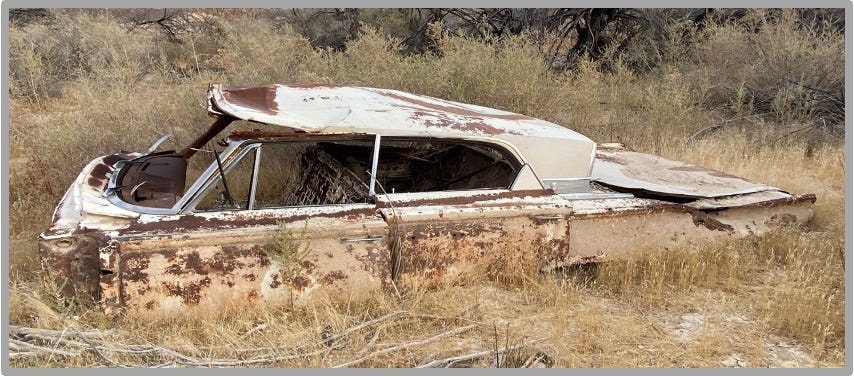
While surveying Five Springs, a remote springs complex on the Refuge, Jeri and I came across a 1960’s-vintage Ford Falcon, sunk up to its axels in the soft Pleistocene lake sediments through which the springs emerged. The skeletonized vehicle had been driven there by a long-forgotten someone for reasons unknown. Hopelessly mired, it had been abandoned to the rust and desert wind. The mining and other threats to the landscape weighed heavily on my mind as we inventoried the springs. In a troubled and dispirited mood I stumbled across the decomposing car in gloriously sparse desert landscape. The old Ford seemed to me to be the epitome of forsaken ideals on multiple levels. Whomever the driver had been, he or she had a long, difficult walk before them back across the arid Nevada landscape. Parallel to the on-going conservation battles here and across the globe, the driver likely had lost much and faced a highly uncertain, and potentially dire future. As I inspected the weatherworn, windowless wreck, its exposed car seat springs, the mess of interior pack rat nests, and its pot-shot bullet holed body, I noticed rust stains on its roof. In those patterns I saw a landscape portending dystrophic cultural decay, one revealing simultaneous similarity and contrast with the desert landscape before me.
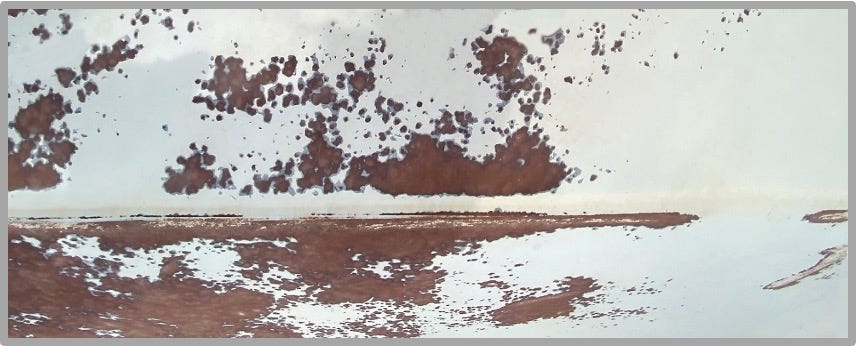
I photographed it with my cell phone and later, back in Flagstaff, Mary Williams (MaryWilliamsDesign.com) helped clean up the image. I see this piece as a warning, a potential future for humanity abandoning its higher values, suffering the loss of natural biodiversity and planetary ecological integrity, loss of our children’s future to the insatiable corporate greed for short-term gain at the expense of the groundwater commons and well-being of our culture. I see it as encouragement to continue moving forward in our efforts, for a better future for all.
Springs are critical landscape features that require specific conservation attention, not only at their surface expression, their biotic assemblages, and their diverse cultural attributes, but also to their supporting aquifers. Ash Meadows is iconic in its unique array of springs and springs-dependent species, and the extent of protection of its aquifer. And fortunately, many residents of the Amargosa Valley also recognize these natural values. Through the tireless work of the Amargosa Conservancy (amargosaconservancy.org) and the Center for Biodiversity (CBD; biologicaldiversity.org), and perhaps with SSI’s letters of support and discussions with Refuge management, the Rover Critical Minerals’ lithium mining plan was abandoned late in 2025.
“The demise of the Ash Meadows lithium project is a testament to the conviction of the communities of the Amargosa Basin in defense of water, wildlife and home,’ Mason Voehl, campaigns director at the Amargosa Conservancy said. “Let this be a clear message to the mining industry: Leave Ash Meadows alone or prepare for a long battle”. However, oblivious to this warning, the Belgian Lhoist Company recently applied for permission to expand its clay mining operation just two miles away in California. So, the battle for protection of America’s hottest hotspot of unique springs-dependent species and habitats goes on and requires consistent vigilance.
We at SSI warmly thank you who support our work on springs, and wish all concerned with these essential, overlooked ecosystems the strength and resolve to continue working together to protect them. Donations to SSI, CBD, and Amargosa Conservancy help enormously, and if you’re near Ash Meadows, the new Visitor Center and the Crystal and Kings Spring boardwalks are well worth the visit.
Well said, Larry. Ash Meadows is vitally important to its inhabitants and to those of us who appreciate native biodiversity. The national malaise is horrific, and you are right that many people have retreated into self-contained vessels of chosen ignorance. Thanks for your efforts. Joanne and I keep fighting too.
Larry,
I enjoyed your tremendous article about the springs in Ash Meadow, and I am doing my best to preserve and protect a local rare spring on BLM land here in Las Cruces, NM. Besides my long professional history of natural resources protection, I am also a huge antique car buff (I have owned a 1934 Plymouth for over 50 years). The actual identity of the car whose photo you included in your article is actually a 1963 Mercury Monterey with a very unique rear window. All the best,
Ken Steigman